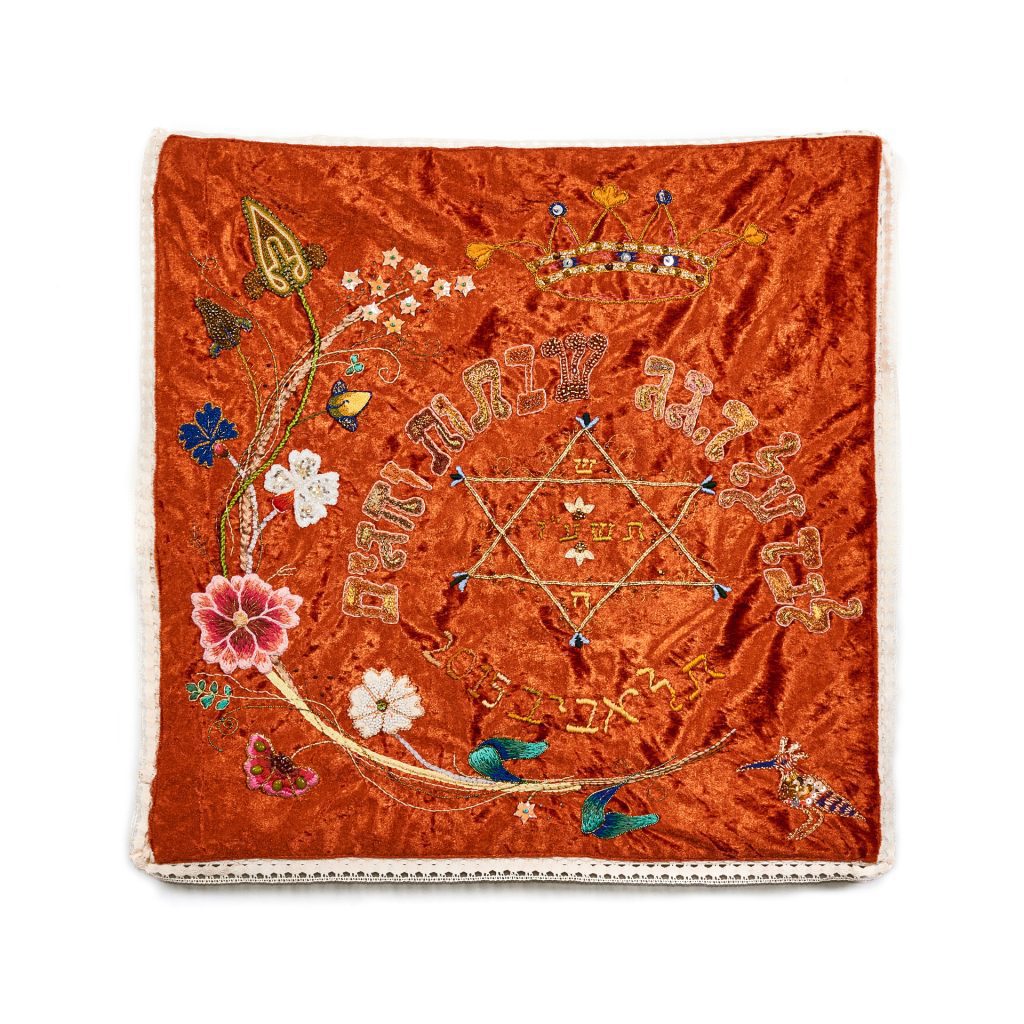
Itamar Sagi )b. 1966(
Alone on the Roof, Sabbaths and Holidays, 2015
Synthetic velvet, cotton threads, gilded threads and lurex threads,
gilded ribbons, glass beads, sequins, linen fabric, linen lace, wick,
industrial ribbons
Courtesy of the Leonid and Tatiana Nevzlin Collection
Must Know
A challah cover is a special cloth used to cover the two loaves set out on the table at the beginning of a Shabbat or holiday meal. The placement of the challah under the challah cover and over the Shabbat tablecloth recalls the Biblical story of the manna which the Jewish people ate every day following the flight from Egypt. The manna, fell every day of the week except for Shabbat. In deference to the holiness of Shabbat, two portions would fall on Friday, enough for that day and for the Shabbat. This is given as the reason for the use of two loaves at Shabbat and holiday meals, as the challot represent the double portion of manna that fell in honor of Shabbat.
Each morning the Israelites found the manna in the fields encased in two layers of dew to preserve its freshness. Thus, we place the challot beneath a challah cover and over a tablecloth (or challah board) to recreate the miracle of the manna at our own Shabbat tables.
Covering the challah so as not to “shame” it while the wine is being blessed is a lesson for the importance of not shaming one’s fellow humans.
The title of this work is based on the song “Alone on the Roof, Shabbat and Chagim” by Israeli songwriter, Yaakov Rotblit (1987) and sung by Yehudit Ravitz. The song tells the story of a lonely woman looking at the happy family of her lover of which she is not part. Shabbat tends to be family-centric causing many singles to feel unsupported and on the periphery of the community. Including this piece in our exhibition makes the statement that Shabbat is truly for everyone and yet can sometimes be lonely
More Info
Itamar Sagi is a textle designer who uses embroidery as an art and design form and is developing a new embroidery language taking this craft to the next level. Traditional Judaica always places the main symbols in the center in a very symmetric composition. This work is asymmetric and lopsided sharing with us the feeling that the world is not always a perfect space. You can see another of his beautiful creations, a Torah Mantle, in the Family Synagogue Hall on the First Floor